Saturday, July 24, 2010

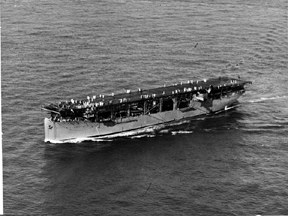
USS Langley at Norfolk

I came across a book in my family's collection called The Complete Short Stories of Guy de Maupassant, copyrighted 1903 by M Walter Dunne, entered at Stationer's Hall, London, published as "ten volumes in one" by Walter J Black Co, 171 Madison Avenue, New York City, and printed in the US. The book is inscribed, "Property of James Thomas Walker, USS Langley, Norfolk Va."

Many of the old books in my personal collection came into my father's hands on a single occasion in the 1960s. His mother, Kathryn Lucilla (Carr) Noble, widow of Robert, had boxes of books she needed to dispose of. And my father coincidentally had a bunch of empty bookshelves in the basement of our home in Landover, Maryland just waiting for some books. Much to my wife's regret, most of them ended up in my personal collection when my father and step-mother were packing to move to Tennessee after his retirement.

Many of the books were from the estate of my grandmother's favorite Aunt Kate Morgan, who died in 1936. The collection has many inscriptions dating back to the 1880s through the 1910s with the surnames Morgan, Pierpont, Tatnall, et al. (My Aunt Kathryn (Noble) Ogg also had a lot of these books in her living room bookshelves.)

Some of the books are those acquired by my father during his World War Two service in Australia. Others are my Aunt Kathryn's childhood books, including an English grammar book, an English literature book, and a Girl Scouts manual, all from the late 1920s early 1930s, some stamped Maury High School and marked with Kathryn's homeroom number.

But I suppose that some of the books must have belonged to Robert, presenting us with the opportunity for additional clues about his family and personal sojourn. I like to think this book suggests an acquaintance between my grandfather and Mr Walker and/or the USS Langley.

Based on History Central's History of Ships and Navies: USS Langley, there are a couple of interesting intersections between that ship and the life of my grandfather, Robert J Noble.
  • Between 1920 and 1924, the USS Langley was retrofitted at Norfolk into the first aircraft carrier of the US fleet, sea trialed in the Caribbean, and exhibited at Washington. My grandfather relocated from Baltimore to Norfolk during this period.
  • Prior to its renaming as the USS Langley in 1920, the collier USS Jupiter became the first ship to pass through the Panama Canal west to east on Columbus Day 1914, while returning from Pacific duty off Mexico during the Veracruz crisis. My grandfather always claimed to have sailed on the first ship through the Panama Canal, but records of the canal's inaugural passage east to west didn't show him aboard that vessel. Perhaps he was aboard this US Navy ship for some reason? Seems unlikely. Ancestry has only limited passenger records for a merchant marine ship called the SS Jupiter, and those are from a landing at New Orleans in mid-1915.
My grandfather lived in Norfolk twice, including the years of the Second World War and those leading up to his death in 1951. He could have picked up the book in those later years and been unacquainted with Mr Walker. But the two items above makes his widow's possession of this book intriguing.

Wednesday, December 30, 2009

Baltimore, Maryland (1918 - 1922)

Family tradition says my grandfather Robert J Noble met his wife, Kathryn Lucilla Carr, in Baltimore, where Kathryn had gone to live with an aunt (1) while looking for work as a teacher. After finding a teaching job, Kathryn found part time work as a bookkeeper at a hotel, where they met and fell in love.(2)


There seems little chance they met in New York City while Kathryn was attending Columbia Teachers College. Kathryn returned to her hometown of Wilkes Barre, PA, after graduation and picked up her teaching certificate, not exactly something a woman would do who planned to court a man living in Baltimore.


According to data provided for a family genealogy (3) by Kathryn herself, she and Robert married on June 7, 1918. The genealogy doesn't provide a location, and the genealogist's records were destroyed by vandals.(4) There is no record of a marriage certificate for Robert and Kathryn in Baltimore City, Baltimore County, or in the Manhattan records of the City of New York.(5)


Family tradition states that one or both families opposed the marriage on religious grounds, supposedly because the bride was Protestant and the groom was Catholic. Whatever if anything might have happened, Kathryn and Robert shied away from their relatives for many years. There were virtually no visits with the children's grandparents, aunts, uncles or cousins. None of the Noble children have any significant recollections of their parents' kin.


The tradition continues that, as a result of this religious conflict, Robert and Kathryn pledged not to foist any particular religion on the children. The children chose an assortment of churches to attend, including Methodist, Episcopal, Baptist and Presbyterian.


Robert and Kathryn had been married about six months when World War I ended on 11 November 1918.


When their daughter, Kathryn Carr Noble, was born on 27 June 1919(6), Robert and Kathryn were residing in the outskirts of northwestern Baltimore city. Robert was working at the Mount Holly Inn(7), a fashionable suburban hotel in the Windsor Hills section(8) of the city. Robert, who lived with his family at the inn, worked in the dining room, apparently his first hotel steward job following years of steamship passenger food service experience.


Their son, Robert James Noble, Jr was born at the hotel on 9 October 1920.(9) There was a terrible thunderstorm that Saturday night, and the ambulance was several hours late, so delivery was accomplished right at the hotel. (10) Kathryn had gone to the hospital earlier, but the doctor sent her home because she wasn't ready yet. Robert was outraged when he got a bill for the delivery room anyway. (11)


Robert was still working at the inn at the time of its great fire, according to his children.(12)


Robert no doubt waited to see whether Cahill would rebuild. When Cahill retired from the Clark Company in 1922, (13) Robert left Baltimore for a job at the Monticello Hotel in Norfolk, Virginia.


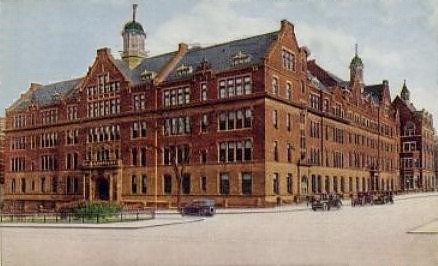
Mount Holly Inn


Vintage Postcards from Cardcow.com
Cardcow.com


Completed in 1900 as a summer resort overlooking the Gwynns Falls Valley from Clifton Avenue, the four-story Mount Holly Inn's 120 sleeping rooms offered Baltimoreans a cool respite from the local summer weather.(14) The inn was located at the corner of Clifton and Lyndhurst in the Windsor Hills and Walbrook sections of Baltimore City.


[The Windsor Hills area, where the inn was situated,] was so "country" that cows wandered up Alto road. Monticello road. . . consisted of two muddy ruts. There was no store of any kind until you got to Garrison boulevard or Walbrook junction. Windsor Mill road was the only decently surfaced street leading into the community. The Mount Holly line No. 1300 streetcar ran along [Windsor Mill road]. (15) 


After the First World War, the Mt Holly Inn was bought and converted to a year-round resort by Winfield Scott Cahill, President and Treasurer of the James Clark Company, marine engine and boiler builders and repairers of steamships. Cahill's parents were both Irish Catholics born in America, his father a Civil War naval hero. Cahill was born in Baltimore on Nov 2, 1861 (16), making him almost thirty years Robert's senior. Cahill held interests in tugboat operations, in harbor dredging companies and marine railways, according to his obituary. A Baltimore Sun piece related the following:

At the Cahill plant, and that of the James Clark Company, of which Mr Cahill was president before the formation of the company which bore his name, were built most of the engines and boilers for the tugs in Baltimore's harbor and the great fleet of steamers which plied the Chesapeake and its tributaries in the latter part of the last and first two decades of this century. (17)

One can speculate that Robert knew or was introduced to Cahill through mutual acquaintances, given the latter's Irish heritage and steamship business connections.


Mrs Helen Boyd was chaperone of the inn.

Under her ever-watchful eyes, couples danced the two-step, gavotte and whirled to the waltz. Dances looked upon as too flamboyant were strictly taboo -- although the "Bunny Hug" and "Grizzly Bear" were accepted innovations. (18)


The inn burned to the ground in its second fire in twenty years, which occurred on December 7, 1920.  

The burning inn, situated on a hill, cast a shimmering glow in the night sky which attracted people from all over the city. . . . When the final flames went out, only a couple of walls and a chimney were left standing. 

No lives were lost and only minor injuries resulted. Senator Ovington E Weller and his wife, who were among the 136 guests the night of the fire, lost all the clothing and jewelry in their room.


Cahill's plans to rebuild never materialized. He tried offering a barn on the property as a dance hall, but the venture wasn't tremendously successful. On the site a recreational center was built and dedicated to Cahill, who donated the property to the city in 1939.

Footnotes

1. Some family members say there was an Aunt Kate living in Baltimore who was quite wealthy and took in her niece. Kathryn's Aunt Katherine Morgan seems to have lived in Wilkes Barre her whole life. An Aunt Laura, possibly Laura Barnes, who lived in Baltimore in the late 1920s, might simply have been a friend of Kathryn's.
2. One story says Kathryn worked part time as a food auditor; another says she was a cashier. She worked with Robert at the Lord Baltimore or the Mount Holly Inn, according to some versions; she worked at the Lord Baltimore or some other downtown hotel while Bob worked at the Mount Holly Inn, according to other renderings. Pat remembers a story about a supply elevator in the sidewalk involving one of these hotels.
3. The Descendants of the Four Grandfathers of Walter Samuel, Jr and Mary Louise (Wootten) Carpenter (Carpenter-Wootten), by George Valentine Massey, 1970, Chart 23
4. According to a May 1980 letter from Massey, "Vandals broke into my house some years ago & ransacked my genealogical files. Some were burnt in the fireplace. So I am afraid I do not have the notes I made for your grandmother."
5. This record should be recoverable once US marriage records are gathered and stored in a national database.
6. Kathryn says her birth certificate states her parents were residing at the Mount Holly Inn at the time of her birth. She adds that her father's place of birth is listed as Red Bank, NJ.
7. Photo on file at Enoch Pratt Free Library, Baltimore, MD, labelled Mt Holly Inn, Dec 1915, Barker 209.
8. Enoch Pratt Free Library, in a letter dated Jan 12, 1993, said that the neighborhood where the Mt Holly Inn was listed as the 15th Ward in a 1924 Baltimore City ward map. This information might help locate the hotel in the 1920 Federal Census. Robert and Kathryn Noble do not appear in the Soundex of the 1920 Maryland Federal Census, based on a search conducted by the writer.
9. Bob says his birth certificate is says West End Maternity Hospital, 103 W Franklin, Ward 15, Baltimore City, MD, which is marked over with the Mount Holly Inn.
10. According to Bob Noble.
11. According to John Noble.
12. It isn't clear why the Noble family doesn't appear in the 1920 Maryland Soundex. Census takers usually would poll hotels in small towns, but it isn't clear what their practice would have been in the bigger cities.
13. Ibid
14. "Windsor Hills Best Known As City Summer Retreat", by Harold I Silverman, The Baltimore American, Dec 21, 1958.
15. "The Early Days of Windsor Hills", by Robert E Base, The Baltimore Sun, Jul 29, 1956. Photo in article has caption: "It was in 1910 that this photo was taken, looking west from the intersection of Clifton avenue and Mount Holly street. The big building is the Mount Holly Inn; the Cahill Recreation Center now occupies the site."
16. History of Baltimore, Maryland, S B Nelson, Publisher (1898), pp 791-2
17. The Baltimore Sun, Sunday Oct 16, 1945.
18. Silverman, ibid

Tuesday, December 29, 2009

Pat Noble and the Second World War (1943 - 1945)

The Draft

My father, Pat Noble, was drafted on 7 Jan 1943 at the age of nineteen. He had a choice to enter the service immediately or take a one week furlough to settle family affairs. He chose the latter option. He wanted to take his mother, Kathryn L (Carr) Noble, up to see her father, George N Carr, but arrangements couldn't be made. Instead, Pat went with his father and brother John up to New York City for a few days.


They stayed at the Barbizon Plaza Hotel at 106 Central Park South. Robert J Noble showed them all around Manhattan, mainly on foot, mostly around Central Park, but also to the Battery and a walk across the Brooklyn Bridge. Robert knew lots of stores, etc. Robert was with his kids the whole time and they never saw any relatives. Robert suggested that they cut the trip short for the sake of Pat's mother, who would want to spend time with her son before he left for the service.

Training

Pat went to the induction center at Camp Lee, a staging area near Petersburg, VA. He went by troop train to Miami Beach, FL, where he spent about three weeks in training. At the end of this brief boot camp, Pat received his assignment to join a military police unit training north of Charleston, SC. He travelled by troop train to a base called Ten Mile, located about ten miles between Charleston and Summerville, SC. The site is now Charleston Airport.

The new arrivals from Miami were supposed to be grouped with a unit shipping out immediately, but at the last minute they were attached to the 1124th Military Police (Army Air Corps) instead and remained at Ten Mile for an additional three and a half months of much needed training.

Pat and four others shared a tent at Ten Mile: Don Dupree (Milwaukee, WI), Ted Glover (Clifton Forge, VA), Eli Rafal (Norfolk, VA) and J J Burns (Milwaukee, WI). Burns was about forty yrs old, the owner of a Buick dealership where Don had worked in Milwaukee (or a Buick dealership associated with the one where Don worked). Don Dupree had been in Miami when Pat was there, but they didn't become acquainted until Ten Mile.

Don introduced my father by mail to his younger sister, Elaine Mary Dupree, and they corresponded throughout the war. The relationship warmed and they married promptly upon Pat's return.

Transportation to the Pacific Theater

The 1124th received orders to the Pacific Theater, where they would guard air bases associated with General Douglas McArthur's operations against the Japanese. McArthur had been forced from the Philippines and was regrouping in Australia. Pat's unit left South Carolina by troop train and assembled at California's Camp Stoneman.

 
A river boat took them to San Francisco Bay, where they boarded the troop ship SS Matsonia (former S S Malolo). En route to Australia they landed in Auckland, New Zealand, where they stayed a couple of days. The local economy wasn't prepared for all the relatively "wealthy" American troops, who ordered up 16 cent steak and egg breakfasts and similar bargains.

Australia

Upon its arrival, the 1124th was assigned for a few weeks at Amberly Field at Ipswich, which is located about forty miles WSW of Brisbane, a major city Australia's east coast. Pat's unit was transferred to Eagle Farm air base at Brisbane, where he was stationed about a year and a half to two years.

While stationed in Brisbane, Pat became well acquainted with the Edgar family: Harry "Pop" Edgar and wife Cass, their son Henry and his wife Doss, and Henry's daughter Gayl. Pat also had his first sinus surgery there.


The 1124th split up into three locations: some moved to Archerfield, right across the bridge from Brisbane; some moved to Eagle Farm; and the rest remained at Amberly Field. Pat and Eli Rafal moved with the group going to Archerfield, while Ted Glover and Don Dupree remained at Amberly Field. During the three months he served at Archerfield, Pat received his promotion to Private First Class(PFC).


Pat then spent a year at Garbutt Field in Townsville, Australia. The Edgars came north to visit him while he was stationed in Townsville.(Pop Edgar, then his son Henry, both died not long after Pat left Australia.)

New Guinea

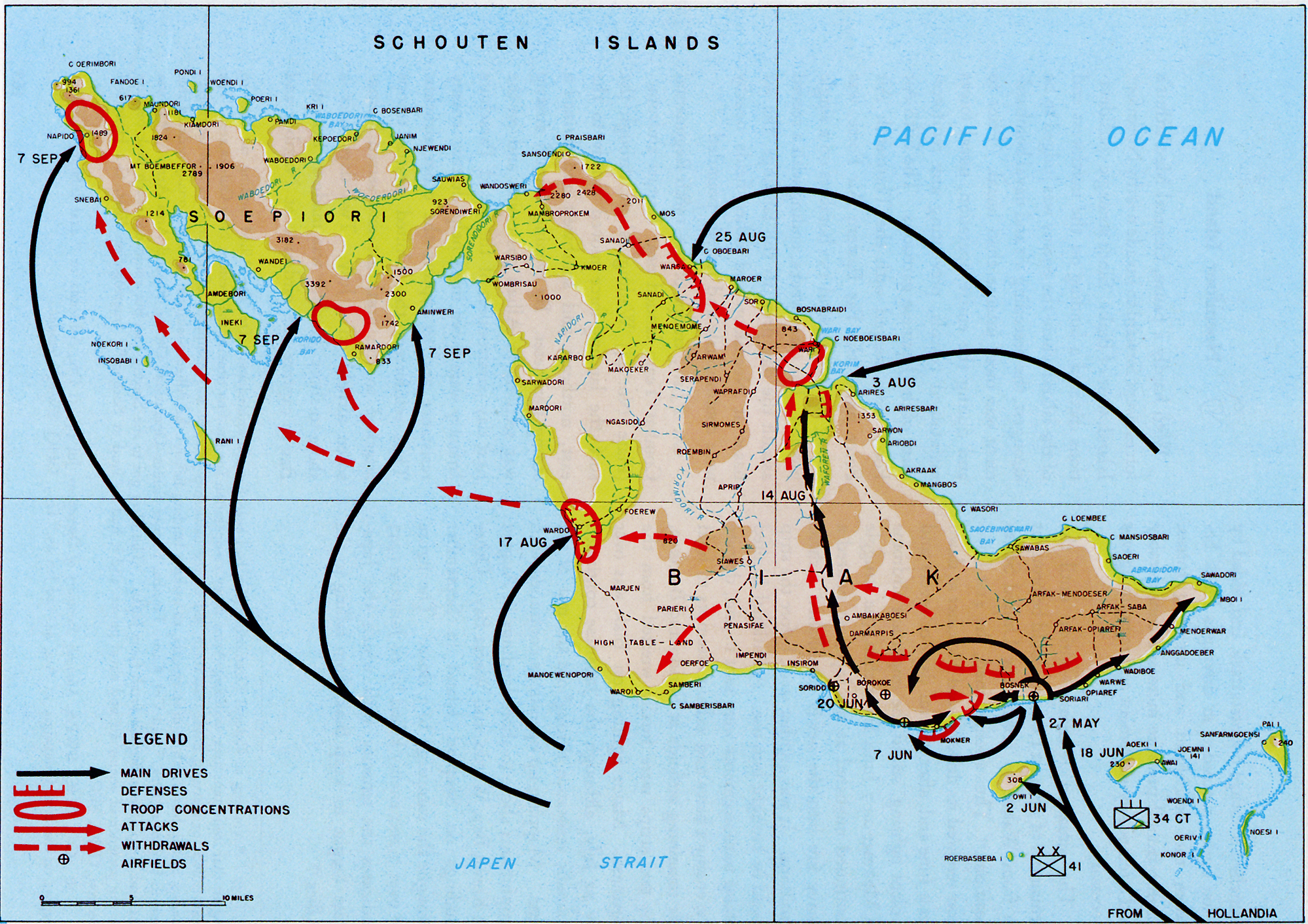
General McArthur and the Allies conducted the New Guinea campaign from Australia. Sometime in the spring of 1945, after the Battle of Biak,  Pat was flown from Australia to Biak, a large island in the Schouten Islands off the northern coast of New Guinea to serve the last few months of the war. He joined his friends Ted Glover and Eli Rafal, who were already there.


During Pat's stay, a Japanese plane dropped five or six bombs on the three airstrips there and killed about two hundred fifty persons. Japanese soldiers living in the nearby hills would regularly come and steal food at the base.


Going Home

Pat, Eli, and Ted boarded a ship for home, stopping briefly [but not disembarking from the ship] at Finschhafen en route to San Francisco. An assignment to provide military police services in Tokyo was in the offing towards the end of the war, but they received their discharges instead. They caught a train east to Fort Bragg, NC, where they left the service. They caught a train together to Norfolk. Pat arrived home 28 December 1945.


Pat walked home, used his door key to enter the house, seeing his mother cooking at the stove in the kitchen for the first time in three years.

New York City (1916 - 1917)

My grandfather Robert J Noble left the Panama Canal Zone sometime after January 1916 and returned to the New York City area to look for work. German submarine warfare had significantly reduced transatlantic commercial shipping, and demand for passenger liner service dried up after the sinking of the Lusitania on May 7, 1915.


Robert supposedly worked briefly at The New York World, a New York newspaper that closed in the 1940s. Among the recollections he related to his children, Robert told of covering a large munitions explosion in New Jersey in about 1916. That explosion was surely the Black Tom Explosion, which took place on the morning of Sunday 30 July 1916, at the National Storage Company on Black Tom Peninsula. The peninsula juts out into New York Bay across from the Statue of Liberty and is currently memorialized at Liberty State Park near Jersey City, New Jersey.


Robert is said to have become friends with Bernarr McFadden, of isometric exercise fame, while working at The New York World.


While local reporting was exciting, Robert wanted to be a foreign correspondent. When he approached his boss, Robert was told he needed overseas experience before he could become a foreign correspondent. His desire to be a foreign correspondent was transposed into something real by the person providing details of his life for Robert's obituary in 1951.


Robert left the newspaper business in frustration after less than a year. Part of his frustration might have had something to do with World War I and the struggle for the sea lanes. The United States had declared war on Germany on 6 April 1917, but Robert wasn't allowed to serve, either because of his age -- he would have been close to thirty years old -- or, more likely, because of his eye injury.


As he walked away from the office, Robert saw a billing for a shipping company offering foreign travel. He decided to ship out right away.

The Panama Canal Zone (1910 - 1916)

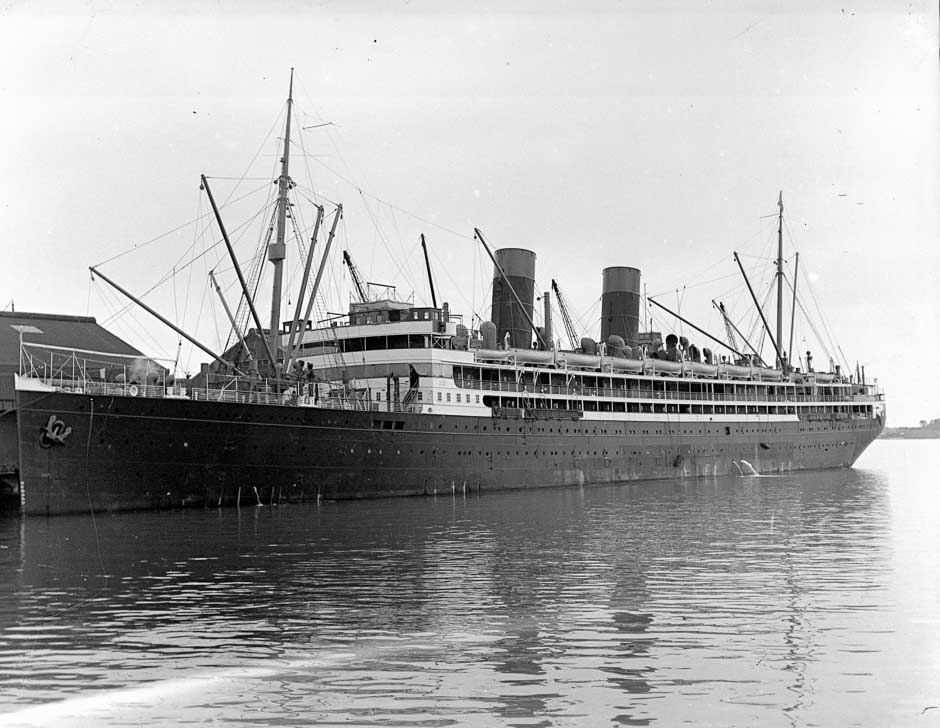
Unsatisfied with the pay and advancement available from Anchor Line, my grandfather Robert J Noble applied for a job with the Panama Railroad Steamship Line while in New York on port of call.(1) By December 1910, Robert had made at least one run to the Canal Zone and back to New York aboard the SS Panama, which operated under the watchful eye of Commander Benjamin Corning.(2) Robert would work on and off as a steward aboard passenger liner cruises between the Panamanian ports of Colon and Cristobal and New York for the next four or five years.


Robert told his children that sailors received premium pay for working in Panama in those days because of the danger of yellow fever.


The SS Panama crossed a point east of the Bahamas(3) on Christmas Day 1910, according to a ship's record Robert kept as a souvenir. The slip of paper was folded up and used to jot down two names and an address: O'Rourke, McVicker, 367 9th, corner of 35th. This address was likely in Manhattan or Brooklyn.


One of his SS Furnessia crew mates, Milwyn Jenkins (likely the man in the photo above, left), wrote often, updating Robert (above, right) on the old gang at Anchor Lines. Milwyn also bundled newspapers from Ireland and left them in New York for Robert to pick up from the Anchor Line clerk when next in port. Much of their correspondence centered on getting a Panama hat for Milwyn.


Jenkins wrote on 15 December 1910 to congratulate Robert on his promotion.


I am certain that you will get on well, and that your company will find that your advancement is to their credit.


Jenkins updated Robert on the old crew. He also told Robert that the Irish lady, Mrs Ross, rode the SS Furnessia last time out of Moville to join her husband in New York. Jenkins said Robert no doubt remembered her.


In his next letter, dated 19 March 1911, Jenkins said Mr and Mrs Ross were still in New York. He added that "the sister Miss Seary" would be making the next crossing to New York out of Moville.(4)


Robert cooked on at least one occasion aboard the TSS California, but almost all of his correspondence came via the SS Panama.


Robert, who had a youthful countenance, grew a moustache to add a few years to his appearance, hoping to gain respect from and authority over his older and brawnier employees.(5)


Robert lost his sight in one eye, reportedly the result of a storm at sea.(6) A receipt from the Eye & Ear Department, Ancon Hospital, Ancon, CZ, to the Eye and Ear Clinic at Colon Hospital, Cristobal, CZ, for prescription glasses dated 14 February 1912, might somehow be related to his accident. His son John recalls his father telling of being in the hospital at Colon, but John put the time frame at approximately 1916-17.


Robert attended the Grand Annual Ball of the Friendly Sons of Ireland, in Colon, Canal Zone, on 15 March 1913.


First Ship Through the Panama Canal


Robert told everyone that he was ship's cook aboard the first ship through the Panama Canal, and there's little reason to doubt his story.(7) There is ample proof that he was in the vicinity at the time; Robert kept a souvenir copy of the breakfast menu from aboard the SS Panama dated 11 August 1914, only days before the official opening of the canal. Many pieces of correspondence and numerous photos show him touring the construction as the locks were still being built.


The official record is silent on the matter, however. The SS Ancon was the first ship through the canal on 15 August 1914, and neither the National Archives nor the Panama Canal Commission could find any records to prove that Robert was aboard.


Robert might have been on an unofficial first ship through the canal, or the first ship to travel the other direction through the canal. Maybe the SS Panama was involved in testing the locks prior to the official opening? Maybe his ship was first to sail from the Atlantic to the Pacific? Then again, Robert might have been aboard the SS Ancon with George W Goethals for the historic event.


Part of the problem in making a final determination is that Robert was not a passenger; adequate records of crew members are not available. Official employment records show a couple of Robert Nobles worked on the canal project, but neither was identical with our Robert.(8)


Robert often boasted of his acquaintance with Goethals, chief engineer of the Panama Canal (1907-14) and governor of the Canal Zone (1914-16), but the proof of same is limited to a stateroom receipt for wine dated 21 December 1914.


Robert made regular runs to New York City(9) throughout this period, based on correspondence with a series of girlfriends he developed in the city and surrounding area.


A Business Opportunity In Peru that Never Materialized (September - October 1915)


There was at least one break in service with the Panama Railroad Steamship Line during this period. When the SS Panama departed New York on September 9, 1915, this was to have been the last voyage for Robert and a fellow steward named Mr Lobley aboard this line. Although they both wanted to quit right away over bitter promotion disputes, Robert and Lobley needed the seed money they would make on this last voyage for a business opportunity in Peru. Also, they would be embarking on their journey to Peru from Panama, with no immediate plans to return to New York.(10)


But Lobley grew uneasy and without a word to Robert abruptly backed out. The day the SS Panama sailed, Lobley showed up instead at Isabel Bolton's New York apartment to explain to Robert's girlfriend why he had quit. Isabel wrote


He told me all about the trouble he had on the boat, and -- well you can hardly blame him, Bob, because it would make you or anybody feel the same. Supposing when you went on the ship the captain said,'Well Mr Noble I have someone to act as first steward so you can keep your old job.'


but she wasn't entirely sure why Lobley was at her place


Well I was more than surprised when he walked in here at three o'clock. I kept looking at the clock and saying,'Well Bob will be going soon'. . . and when he came up gee I almost drop[p]ed dead. I thought -- well, maybe something had happened to you.


While Lobley promised to say his goodbyes to a sweetheart and be at the dock ready to leave for Peru when the SS Panama returned, Isabel was wise enough to realize that Lobley might never follow through on the business deal in Peru.


But on the other hand, it is the last trip and of course the money will make quite a lot of difference to him on account of going to Peru. . . . Maybe he didn't care so very much to go away anyway?


Robert's friendship with Lobley soured and the Peru adventure fell through.


By early November 1915, Robert returned to the SS Panama, back to a Second Steward position. A Mrs Donovan of Brook Haven, New York, a frequent passenger on the SS Panama who knew Robert and his former girlfriend Alma quite well, put in a good word with a Mr Foss at the Panama Railroad Steamship Company. This same Mr Foss wired greetings to Robert from the SS Bunker Hill on the occasion of Robert's last voyage aboard the SS Panama on September 9, 1915. Mrs Donovan got Mr Foss to agree that if Robert wanted his job back, the line would look upon Robert's absence as a vacation. Robert evidently stayed with the SS Panama at least through January 1916. [Donovan letter; Foss telegram]


Robert's son John says his father was chief steward for McCormick Line and Grace Line Steamship Companies, buying supplies for a fleet of six or seven freighters operated out of the Canal Zone. The USS Florida played a part in this scenario, according to John's recollections. This information doesn't fit very neatly into Robert's profile, but should not be discounted entirely.


Alma Wurdemann


Robert's girlfriend in 1913 was Alma Wurdemann, who lived with her mother, Mrs Henry Wurdemann, in Panama.


Robert and Alma apparently socialized over a period of months whenever Robert was in port from his steward's job aboard the S. S. Panama. Alma was clearly interested in developing the relationship, based on her letters to Robert.


The Wurdemanns were former residents of Jersey City, NJ. When Alma and her mother visited relatives in Jersey City Heights, their social itinerary rated a brief mention in their former hometown paper, The Hudson Observer. Alma sent Robert a copy of the article and wrote below it "Guess who?"


Alma and her mother spent the rest of June visiting local friends and relatives, including Alma's nephew and his parents. Robert steamed to Panama and back during this period. Alma made arrangements for Robert to meet her and her mother at the Hotel Shelburne in Brighton Beach, Brooklyn, upon his arrival aboard the S S Panama on July 1, 1913. Alma was disappointed when, for some reason, Robert couldn't meet Alma as soon as his ship docked. Robert was to take the train to Brighton Beach from the station at Brooklyn Bridge.


By the end of June 1913, Alma was making elaborate arrangements to meet Robert in Brighton Beach, New York, upon the arrival of his ship on 1 July. When Robert said he couldn't see her on his first day in port, Alma fully expected to see him the next day and provided directions.


Alma and her mother returned to Panama in July 1913. Soon thereafter, Aunt Alma and Grandma invited Alma's nephew down for a visit. The boy was to accompany Mr Noble aboard ship from New York to Panama. There are several photographs, probably taken in Panama, showing Alma and Robert with her nephew and his parents.


On 26 August 1913, Robert wrote Alma from aboard the SS Panama to say that the ship was returning to New York for major repairs and wouldn't make it back to Panama for an indefinite time. A bit melodramatic, Robert claimed that the ship was sinking but that the captain thought they would make port. He was heartbroken to not be seeing her as they had planned; Robert had been counting the days and hours since they last saw each another.


On October 21, 1913, Robert took in a musical comedy in two acts called "The Three Twins" at the Garden Theatre in Colon, probably with Alma.


Alma eventually married another.


Isabel Bolton


His next girlfriend, from 1914 to 1916, was Isabel Bolton. Her family had society contacts and the household had a maid, but the budget was evidently quite tight around the Bolton residence. Isabel lived in a New York City apartment at 150 W 36th Street, at least from September to November 1915. She and her parents moved to a house at 10 Ocean Port Ave, Box 70, Long Branch, New Jersey, in early November 1915, telephone Long Branch 847.


Her sister Eunice was a rowdy New York girl who at least once was arrested for solicitation to prostitute. Robert threatened to put her over his knee when he got back in town, but sassy Eunice only ventured that he would probably like that, and pointed out that she knew a few juicy tales about Robert!


The relationship with Isabel seems to have been more trouble than it was worth to Robert. He evidently didn't like travelling down to Long Branch to spend his leaves with Isabel and her parents. He started to avoid her and not return her letters or even call when he was in port. Isabel speculated in her writings on the direction of their relationship, then the letters stopped.


Footnotes

1. Several blank copies of the Panama Canal Steamship Line's application form survived in Robert's special correspondence folder.
2. The Reference Librarian at the New York Historical Society found the SS Panama in the Record of American and Foreign Shipping, ed 1910 and ed 1917. The 4,193 T ship was built in 1899 in Philadelphia, PA, by William Cramp & Sons S & EB Co. It was owned by the Isthmian Canal Commission. It sailed between New York and Colon. Its master was (Benjamin) Corning.
In a separate reference, she found that the Isthmian Canal Commission expired in 1914. This commission became the Panama Canal Commission, which existed until 1979, at which point the Panama Canal Treaty required that a new commission be set up.
3. "SS Panama at meridian 25 Dec 1910: Latitude 25 degrees 53 minutes North, Longitude 74 degrees 20 minutes West, Distance 341 miles, Benjamin Corning, Master." Form No. TS 59 20 Pads May 1910.
4. Possibly Miss Seary is Mrs Ross' sister.
5. According to his son, John C Noble.
6. One story says a hatchway latch snapped loose and struck him in the face, forcing the eyeball from its socket. Another says a cinder somehow lodged in his eye while at sea. Surgery reportedly included the temporary removal of his eye without anesthetics. The eye was not lost, but surgery failed to restore his vision. This writer's personal favorite was offered by Bob Noble, who said his father lost his eye when a chandelier fell on him at the Lord Baltimore hotel.
7. His son Pat suggests that his father might have been aboard the ship but not a member of the crew.
8. The Panama Canal Commission Vital Statistics Unit replied to my inquiry on 24 Sept 1992, providing copies of employment records for a Robert E Noble and a Robert H Noble, both recipients of the Honorable Roosevelt Medal (medal no 3032 and 5445, resp)(1st bar no 1853 and 3385, resp). Robert E Noble was employed by the Canal from Jan 1910 to Jan 1914 as a locomotive engineer, starting at $140/mo, then $180/mo, finally $210/mo.
9. A January 1915 dental receipt from Brooklyn shows that Robert was quite at home in New York.
10. This explains the "Greetings and Good luck" goodbye message to Robert from M Foss on 9 September 1915.

Mary J Scott

My Grandfather Robert J Noble corresponded in April and May 1913, with Mary J. Scott, of the Union Steamship Company of New Zealand. Until earlier that year, Mary had worked as a stewardess for Anchor Line Steamship Co, of Glasgow, Scotland, apparently making runs between Glasgow; Londonderry, Ireland and New York. At some point during her years with Anchor Line, Mary seems to have made one of that company's runs through the Suez Canal, feeling the brutal heat of the Red Sea.


She and Bob became well acquainted as shipmates, fell in love, and continued to stay in touch after Robert left the company in New York to join the Panama Canal Steamship Company in late 1910. They probably served together on the S. S. Furnessia. Mary still held affection for Robert almost three years later, writing him love poems and sharing her intimate plans. She and Robert saw each other in New York from time to time when their ports of call coincided. Robert probably was writing her, too, based on her knowledge of recent events in his life.


Mary decided in early 1913 to change companies and sail for Australia to join some well-to-do cousins living there. She was apparently a single mother, because she left some sons behind, presumably in Scotland. She wrote Robert about her hopes for Australia in a letter dated April 1, 1913, from aboard ship off Port Elizabeth, South Africa, on her way from New York to Sydney, Australia.:


I hear [[Australia]] is a lovely country. Everyone you hear speak, and they tell me I will never want to leave it. However, time will tell. Should I not like it I will stay, say, for three years and come back if God spares me, and if my boys are good and steady I won't need to go to sea.


Before her last trip from Glasgow to New York, as can be derived from her letter, Mary said farewell to her sons, whom she apparently put in boarding school in or near Glasgow, planning to "get them out" as soon as her prospects improved.


It was a terrible parting with boys and, believe me, I have a good cry every day some part or other. I must work my finger ends off to get them out soon. . . .


Well! I cannot say yet that I rejoice at change of Company . . . However, I must make the best of it now -- It was for my boys sake that I have done it & I believe it will be all right in the end....


She quit her stewardess job with Anchor Line when she got to New York. The crew threw her a goodbye party there.


I was well treated by my shipmates and [chief steward] before leaving. The ladies bought me a handsome box of underclothing & Mr. Gordon gave me [a one pound note] to buy gloves & anything I needed, & Baker made me a lovely iced cake. I appreciated them all very much.


Mary referred to a number of mutual acquaintances in her two letters. In her April 1 letter, Mary sent regards through Robert to poor old Brady. In her May 20 letter, she seemed to allude to Robert's frustration at not being a Chief Steward yet, given his age, and his idea of leaving the S. S. Panama to go into business with Brady:


I hope you are making lots of money Bob & taking care of it too. It is a wise plan & now is your time. [Chief Stewards] in this [Company] are mere boys & run the bars (both [Chief & Second Stewards]) They are much more refined than Anchor Line.


Mary also referred to Miss D. In her April 1 letter, Mary said Miss D had not written to Mary recently. The Niagara sailed from New York before the mail arrived, Mary told Robert, so she didn't know if Miss D had sent her a letter. Mary asked Robert to remind Miss D. to write. In her May 20 letter, Mary said Miss D still hadn't written.


Mary referred to Clara in her April 1 letter with the following remarks:


I do miss Clara every day & I will never forget the happy night we all spent to-gether, but what a sore heart I had all the same, I never closed my eyes that night. . . .


Mary left Anchor Line and joined the crew of the RMS (Royal Mail Ship) Niagara, leaving New York for Sydney, Australia. Mary found out shortly after setting sail that the Niagara would be reverting to a Sydney to Vancouver (Canada) run, making the trip too long for her to bear. She presumably was referring to the Anchor Line run from Glasgow when she said New York "was quite long enough."


. . . I hear all will be different when we get to Sydney & she gets into her proper run to Vancouver. I'm very much afraid I will never run to Vancouver with her. The long voyage is simply disgusting. N[ew] York was quite long enough.


Her ship crossed the Equator on Easter Sunday, March 23, 1913.


We crossed the Equator at 1:30 pm Easter Sunday. I didn't feel her bump, but a terrific thunderstorm. I felt heat in Red Sea much worse but it was bad enough. We expect to arrive in Durban (where I expect to go ashore and post this) Thursday aft. & coal & leave again Sunday for Melbourne & Sydney.


Mary posted her letter from Durban, South Africa, when the ship made port of call on Thursday afternoon, April 3, 1913. She liked the ship itself, if not the workload, according to her letter, and the captain seemed to have plans to bring Mary out of the lower holds of the ship, making life a bit easier for her before reaching Sydney.


The ship herself is certainly a marvel. My room is just lovely & every comfort & convenience, but away from my passengers. Captain Gibb has condemned it & says a room has to be got ready on promenade deck for Sydney for "Chief Stewardess" (That's me)


Mary struggled to keep up with her duties, climbing several decks to service her passengers. She complained of having to do the work of three persons. The chief steward wouldn't allow the use of the elevator by the stewardess because there were so few paying passengers; the bulk were Union Steamship Co employee families. As a result, Mary was always tired, and very unhappy. She missed home. And she missed Robert, hoping to see him again someday.


I feel very, very miserable and unhappy, Bob. Sleep and I are strangers now, and I feel just worn out. Am doing work of three stewardesses which is very hard. And the lifts are not working until we get to Sydney. Chief Steward declines to use them for class of passengers we are carrying beds I have about doz real live saloon, & rest are wives and daughters of U.S.S. Co. Employees. . . .


Will we ever meet again Bob[?]. I can't think that we won't. I really would like to meet again. . . . I have pictured you many times Bob & my thoughts are often with you, I can tell you.


Now dear Bob I trust you are well & much happier than I am . . . As soon as you get a new sailing list you might let me have one. I will look [at] your list & see when you will be in [New York] & wish I could have been there too. I never thought I could have been so homesick & unhappy.


After refueling, Mary's ship sailed from Durban on Sunday, April 6, 1913, heading for Sydney, Australia via Melbourne. Based on her May 20, 1913 letter, Mary was met upon her arrival in Melbourne by the ex-Mayor of Footscray, Melbourne. This prominent member of the community invited her to his home and claimed he was willing to take her boys in when they were ready to come to Australia. It is unclear from context whether J Samuel Johnson is one of the very wealthy cousins referred to earlier in her letter.


I have some very wealthy cousins in Melbourne, & Councillor J Samuel Johnson (last year mayor of Footscray, Melbourne) came to see me on Niagara & to take me home with him & says he will see to the boys when they are ready to come, so my mind is easy on that score.


As predicted, once she arrived at the offices of Union Steamship Company in Sydney, Mary concluded that Vancouver was too long a trek. So she volunteered to serve aboard an inter-colonial run, five weeks from Sydney to Melbourne and back, hitting intermediary points in New Zealand and Tasmania. The ship sailed from Sydney to Wellington, New Zealand, then hit ports along the New Zealand coast (Lyttleton, Dunedin, and the Bluff) before heading over to Hobart, Tazmania. They called in Melbourne for three days, then reversed the trip (Hobart, the Bluff, Dunedin, Lyttleton and Wellington) back to Sydney. Mary pointed out that the Bluff is the most southerly point of land in the world.


Quite the opposite of her experience on the Niagara, Mary found there was too little work to do aboard ship. Furthermore, she soon learned that all the big tippers were aboard the ships crossing the Equator, running between Australia and America or Britain.


Well! I am not stuck on this [Company] as yet, & don't think ever will. Have very little to do, & not any beds to make in any port, only when at sea. Got a kind & courteous [Chief Steward] & we can go out at any port -- sailing day [or not], it doesn't matter. Don't turn out before 4 o/c morning & set up with [Chief & Second Steward] at table in Saloon in port & at sea. All the same I am very, very unhappy, more ways than one. . . .


There isn't any nobility travelling here. Best people are between Britain & here or America & here. I won't say to anyone what I have said to you. Believe me, Bob I have cried myself to a skeleton almost & will never settle until I am crossing the Line again. . . .


She wanted to get back on a ship heading north, as did many former Anchor Line employees in Australia.


I have met a lot of Anchor Line boys here & met 3 or 4 [Stewards] from Glasgow & all are anxious to get home, but I've never said I'm trying to get back. I do not regret leaving Anchor Line not for one moment, but I would have liked to have met you occasionally. . . .


Mary quietly began to use her contacts to find another job which would land her north of the Equator part of the time. She even found a promising job offer out of Glasgow, where she could see her sons for a few weeks three times a year.


Don't say a word to a soul, Bob, but I have the chance to get into Blue Flannel Line (Holt's) running from Glasgow to Australia & I am going down to "Auslines" when I am in Melbourne June 3rd to interview [Chief Steward] to see if I can get a position there. Manager in Sydney thot of me & told me I had to see all [Chief Stewards] as they came in until I got back to Glasgow & then I would be taken on there. I would like it better & would have 2 or 3 wks at home & see boys every 4 months & get them out with me when they were ready. I would like that better Bob & would be a bit happier.


John Campbell, one of her fellow Union Steamship Company crew members, was arrested for stealing from a passenger. Mary said Campbell, with whom she was well acquainted, was a former Anchor Line employee; Robert apparently did not know Campbell. As a result of his thievery, the Company fired all their Scotch and English employees, save Mary. It is unclear from her remark whether she was Scotch and they fired all her fellow countrymen, or if she was Irish.


The Electrical Engineer on this boat was a John Campbell (late of Anchor Line) & he is in jail now for stealing one of 2nd cabin passengers bag & jewellry to the value of L 19 - 10. I knew him well. Isn't that a scandal, so they have sacked every man (Scotch or English) I am only man left on.


Mary thought she might end up making a run to San Francisco when she returned to Sydney from her inter-colonial run because the ship had been hired to conduct a survey.


They change you around here very much, & I might be sent to San Francisco when we get to Sydney as she is taking up Aorango's sailing for a trip for survey & then perhaps another ones. However if I do I will write you from Frisco. You might see in shipping news I guess you will.


Mary continued to miss Robert. She would remember him fondly for taking her to the show. Taking in a theatre performance was always a favorite pastime for Robert, according to his son Pat.


Now Bob take care of yourself & think how I would love to be beside you when you are sitting in a theatre. I've never been to one since I left you & I don't think I will ever again until I see you. Now with all my best wishes & every thing that is good & write soon, soon to your loving old pal, Mary.


Mary ended her letter with a poem:


'Tis hard to say "Goodbye"
'Tis A word that causes pain,
But as the years go by,
Perhaps we'll meet again.
And if we never meet again,
I hope you won't forget
To often cast one little thought
To one who loves you yet.
MJS

Monday, December 28, 2009

Bob Noble Promoted at Battle of the Bulge; Wounded at Andernach

My uncle Bob Noble, son of Robert and Kathryn (Carr) Noble, served in Company B, 63rd Infantry Battalion, 11th Armored Division during World War II. In the spring of 1944, the Division was at Camp Cook, California [present day site of Vandenburg AFB], for training in preparation for transfer to Europe. Bob was Squad Leader (Third Squad) at rank of Staff Sergeant, with about a dozen soldiers under his command. The Platoon Sergeant (Second Platoon) was Technical Sergeant Cohen, and the Platoon Leader was Lieutenant Sabatini.

In Sept 1944, the Division traveled by troop ship to Europe. They were supposed to land in France, but landed in southern England instead, where Patton's Third Army took their equipment. They were stationed until further orders at Warminster, northwest of Salisbury in Wiltshire, England. According to John S. D. Eisenhower's "The Bitter Woods" (1969, New York), the 11th Armored Division was on reserve status at Supreme Headquarters, Allied Expeditionary Force (SHAEF) until nearly the end of the year. (Eisenhower, pp 379-80, 409-10)

When the German counteroffensive of mid-December 1944 occurred, the 11th Armored Division was already enroute to France across the English Channel. Bob thinks they were on their way to a light assignment in Brest, France, when unforeseen events overtook them on 16 Dec 1944. Instead, they landed at Cherbourg, France and headed straight to the front to join Patton on the Meuse River in Belgium.

That is probably why the sources are all so vague regarding the 11th Armored Division's status at the beginning of the German counteroffensive. "The Marshall Cavendish Illustrated Encyclopedia of World War II", by James Collins, Jr (1972, New York) states that the 11th Armored Division was transferred to the Third Army on 23 Dec 1944 near Bastogne. This was reportedly to help Patton cover his left flank after a German tank advance. (pp 2153-4) Eisenhower's book says that the 11th Armored Division was at SHAEF on 16 December 1944, and General Eisenhower ordered the 11th Armored and 87th Infantry Divisions attached to General George Patton's Third Army to the south of The Bulge on 28 Dec 1944. The 11th Armored Div was situated at a backstop position behind the Meuse River for a few days, then was moved toward Neufchateau. (pp 409-10, 416)

On 30 Dec 1944, Patton placed the 11th Armored Division to the west of the narrow supply line into Bastogne held by the Allies. They were under command of Troy Middleton, head of VIII Corps, with the mission to move northward. It was hoped they would come abreast of the 101st Division, which was under seige at Bastogne. At 8 am, the 11th Armored Division saw its first combat in the war, repelling a major German counterattack by Panzer Lehr and the 26th Volksgrenadier, who were trying to isolate Bastogne by cutting the supply corridor mentioned above. (Eisenhower, pp 409-10, 416)

Lieut. Sabatini's platoon saw its first action of the war on 30 Dec 1944. Sgt. Cohen was wounded on the first day of battle, so Bob was promoted in the field to Tech Sergeant and became the new Platoon Sergeant, overseeing four squads totalling up to fifty men.

Patton considered 30 Dec 1944, a critical day and was anxious to get on with the attack, so he pressed the 11th Armored Division into service without sufficient time for bringing up the rear, for reconnaissance or for preparation. Patton would later be critical of Middleton for lack of aggressiveness in his pursuit of the enemy, given that the battle results fell short of expectations and were a piecemeal affair. (Eisenhower, pp 409-10, 416)

The next day, the Third Army saw seventeen German counterattacks. The weather worsened, with sleet and snow. Both sides suffered heavy losses, mainly along the corridor to the west of Bastogne. The 11th Armored Division suffered particularly heavy losses since it was their first combat experience of the war versus a veteran German opponent. (Eisenhower, pp 409-10)

Bastogne was rescued.

On 16 Jan 1945, the 11th Armored Division was a major participant in closing the pincers on the Germans on Houffalize. Many Germans were caught in this snare, which effectively ended the Battle of the Bulge. The actual Allied lines at the beginning of the counterattack as of 16 Dec 1944 were not restored for another twelve days, however. (Eisenhower, pp 428-9)

Eisenhower's book summarizes the battle from Bastogne to Houffalize. (pg 430). It provides asituation map as of 3 Jan 1945, showing the 11th Armored Division in reserve to the southwest of Bastogne. (pg 414) Another situation map, as of 15 Jan 1945, shows the 11th Armored Division northwest of Bastogne nearing Houffalize. (pg 427)

The Third Army then attacked the Eifel Forest. (Eisenhower, pp 437-8) By the second week of January 1945, Patton had reached the Moselle River in Luxembourg, the Sure and Our Rivers, with the aim of reaching the Rhine River at Koblenz. (Collins, pg 2289)

By 4 Feb 1945, a strategy was being formulated by Eisenhower to get past the Siegfried Line and conquer the Rhineland. He developed a three phase attack: Operations Veritable, Lumberjack and Undertone. (Eisenhower, pp 437-8)

As part of Operation Lumberjack, Patton's Third Army moved northward along the Rhine while the 1st Army moved southward, thereby squeezing the Germans out of the territory in between. (Eisenhower, pp 437-8)

The 11th Armored Division, under Major General Holmes E Dager, was situated to the left of Hugh Gaffey's 4th Armored Division, which reached the Rhine River above Koblenz on 5 Mar 1945. On the same day, the bridge at Remagen was taken by the 9th Armored Division. (Collins, pp 2289-90)

Bob says the 11th Armored Division reached the Rhine River north of Koblenz at Andernach on 3 March 1945.

The Third Army's 4th Armored Division reached Andernach, Germany, on the Rhine north of the Moselle River, by 7 Mar 1945. (Eisenhower, pp 437-8)

Bob says the Allies immediately launched a series of Allied assaults on Andernach to expel the hardened German soldiers in position in the town. Tanks entered the city and the battle ensued. The attacks began to show results.

A German retreat from key positions in the city was underway by 9 Mar 1945. Bob's squad received orders that day to neutralize a machine gun nest in town which had a disabled Allied tank pinned down. While the tank driver watched, Bob and a fellow soldier headed down the narrow roadway facing the machine gun nest, drawing the German's attention while the bulk of Bob's squad rounded the building for an assault from the side.

When Bob ducked into one particular alcove, however, a German soldier not cleared from the building Bob was using for cover, shot Bob in the shoulder with a German Luger pistol through an open window at close range. Bob later learned that some of the Germans had been trapped inside this building in the assault and hadn't retreated like everyone thought.

Bob thought he'd lost his arm in a cannon blast, but a quick glance revealed his unfeeling gloved hand still present and accounted for. He ordered the soldier accompanying him to retreat, which he did. By the time a medic appeared, the German machine gunner was spraying the street with gunfire. With shots flying between his legs, Bob convinced the first medic to abandon any attempt at a rescue. But a second medic was more persistent, succeeding in urging Bob to evacuate his position.

The 11th Armored Division made first contact with the 1st Army near Brohl on 11 Mar 1945. (Collins, pg 2290)

Bob was sent to a neurological center for rehabilitation at White Sulphur Springs, WV. He was released from the service in October 1945 and married a month later to a therapist who worked at the hospital at White Sulphur Springs. They had a ceremony in White Plains, NY, where the bride's parents lived.

Bob applied and was accepted at the University of Chicago Law School. Bob always admired graduates like Robert Maynard Hutchins and Mortimer Jerome Adler and was surprised to pass the entrance exam. Bob and Jo went to Cleveland, OH for the interim until school started. Jo worked at the Veterans Hospital in Cleveland during that time in her field as occupational therapist.